Web development
The decision making process: A thought process
Did you eat breakfast this morning? What did you have? How did you arrive at your choice? Did you sit there and think
By Best Web Design | Published 31 July 2019 · Updated 29 January 2025 · 3 min read

The secret code to unlocking secrets in our design world

The Appearance of Rationality
We all think we’re rational, sensible people who weigh up the choices and make careful decisions. Yet, that’s not really how we work. We may give a moment to debate between a couple of breakfast options, but we give no more thought to it than that.
The truth is that the vast majority of our decision making is processed at a sub-rational level. Many of our decisions are made on autopilot; we fall out of bed, stagger into the kitchen, put some bread in the toaster and make a cup of coffee. It’s just a routine.
Yours may be different from mine, but it’s the only way we can cope with the vast array of choices we make every minute.
—Daniel Kahneman, Nobel Prize-winning economist and behaviourist
The same is true for Decisions People make on the Web
Let’s say you want to buy a new television. A quick Google search will reveal thousands of websites that sell televisions. You won’t visit them all. You won’t review every model of television on the market.
You’ll visit a few websites, perhaps cast around for a little information, and then you’ll buy a television. A television is a big purchase for many people, but it’s not so big that it requires a month’s research to make a decision.

You won’t consciously realize it, but your purchase will be influenced by the site’s design, the placement of products, and the way the company has presented them to you. Choosing a television feels like a rational choice. In truth, it’s not really, at least not for the vast majority of us.
(There will always be a minority, including technophiles and those who love reading manuals for pleasure, who compare specifications in detail, but most people either can’t be bothered or they don’t really care about them.)
It’s a decision that we will simplify into a series of small steps, each of which seems rational but which is—in fact—irrational. Most of the decision is made in parts of the mind that we don’t have any way to access consciously (hence the passive nature of this ‘activity’). The biggest conscious action is executing that decision, not making it.
An example that shows just how taxing weighing up all options can actually be is military strategy. Take a typical conflict or peacekeeping effort. Assuming the adversaries are competent, those in the high command on both sides will wrack their brains to consider the consequences of actions—anything to avoid having to rely on second-guessing the opponent’s next move.
With the pressure on, many heads have to join together to work out every possible move (i.e., choice) and the knock-on effects of taking it, likely responses to these and the cost of delaying actions—although sometimes, albeit rarely, taking no action is the best action.
The above example is, thankfully, an extreme case where humans have to work against this aspect of human nature. Happily, as designers, we can rely on the same tendency that’s involved in choosing a TV when we work for our users.
Finding ourselves to lack such a high degree of rationality may seem like a rude awakening for those of us who consider ourselves careful, level-headed analytical types, but it’s something we can use to our advantage.
A strong point to bear in mind is this—at Best Web Design don’t trick our users into doing what we want them to; instead, we show our options in a manner that helps them make decisions in a natural way that will benefit them, first, and then—by the effect of their actions— us.
To conclude
Decision making is a sub-rational process, occurring at levels deep in the mind. While we often believe that we make decisions in a rational manner, being “truly rational” in decision making is an impossible goal to achieve in reality. We simply cannot weigh up all the actions available to us in any given situation and measure them against each other.
Thus, we need to take shortcuts that lead to making decisions; these decisions will feel rational but are not. All this may sound like a disadvantage, but it’s a fact you can and must tap to your advantage in guiding users to desirable actions in your designs.
Keep exploring

Web development
Web Development Company Services: From Custom Websites to Web Applications
Every business today needs more than an online presence. It needs a digital platform that works as hard as the team behind it. This is exactly
Web development
Web development
Website Accessibility (WCAG) Guide for South African Businesses in 2026
Website accessibility means designing a site so people with visual, auditory, motor, or cognitive disabilities can use it fully.
Web development
Web development
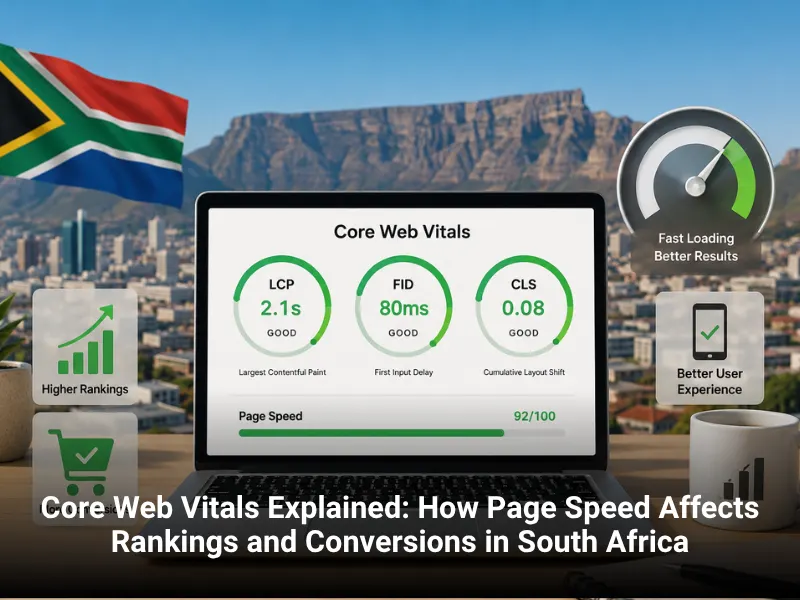
Core Web Vitals Explained: How Page Speed Affects Rankings and Conversions in South Africa
Core Web Vitals are three Google metrics, loading speed, interactivity, and visual stability, that measure real-world user experience and directly influence search rankings.
Web development